
Buying commercial property is a major investment, and understanding the nuances of financing is critical to your long-term success. Whether you are looking to purchase your first storefront, an industrial warehouse, or a multi-unit residential complex, the way you fund that asset will determine its profitability.
Many business owners assume commercial mortgages work like residential ones, simply because they involve a property and a lender. However, this is a common misconception. In the commercial world, rates, terms, and approval criteria are significantly more complex and carry a different set of risks.
Before you sign on the dotted line, it is essential to understand the unique landscape of commercial mortgage solutions in Canada. This guide provides an in-depth look at everything a business owner needs to know about commercial financing in today’s market.
Expert Tip: Don’t navigate the commercial market alone. Speak with a mortgage expert to understand how specific lender requirements apply to your unique business situation.
What Is a Commercial Mortgage?
A commercial mortgage is a loan secured by real estate that is used for business purposes or to generate income. Unlike a residential mortgage, which is primarily based on the borrower’s personal income and credit score, a commercial mortgage places a heavy emphasis on the property’s ability to generate revenue.
Common property types that fall under the commercial umbrella include:
- Office Buildings: From small professional suites to large corporate towers.
- Retail Spaces: Including shopping malls, strip centers, and standalone retail outlets.
- Industrial Properties: Warehouses, manufacturing plants, and distribution centers.
- Multi-Unit Properties: Generally defined as residential buildings with 5 or more units.
- Hospitality & Specialized: Hotels, motels, and even farmland.
Understanding the differences between personal and investment property mortgages is the first step in recognizing that commercial lending is a different beast entirely.
How Commercial Mortgage Rates Work in Canada
In Canada, commercial mortgage rates are not “one size fits all.” Lenders view every commercial deal as a unique risk profile. While residential rates are largely influenced by government bond yields and the Bank of Canada’s overnight rate, commercial rates are also heavily influenced by the specific risk of the industry and the asset itself.
Fixed vs. Variable Commercial Rates
Choosing between a fixed and a variable rate is a strategic business decision.
- Fixed Rates: Provide stability and predictable monthly costs, which is ideal for businesses with tight margins or those who want to lock in expenses for a set term.
- Variable Rates: These are typically tied to the Prime Rate, which currently sits at 4.45% (as of May 2026). Variable rates can offer lower initial costs and flexibility, but they expose the business to market fluctuations.
For a deeper dive into which might suit your cash flow, see our mortgage comparison guide for choosing the best option.
What Influences Commercial Mortgage Rates?
Several factors determine the interest rate a lender will offer your business:
- Property Type: “Low-risk” properties like multi-family residential often get better rates than “specialized” properties like gas stations or restaurants.
- Business Financials: Your Debt Service Coverage Ratio (DSCR) is king. Lenders want to see that your business generates enough net operating income to cover the mortgage payments by a factor of at least 1.2x to 1.25x.
- Loan Size: Larger loans may attract lower rates from institutional lenders, while credit unions may offer different pricing tiers for smaller “small-business” loans.
- Market Conditions: Global economic factors and the Bank of Canada’s policy rate directly impact the cost of funds for lenders.
Your financial goals influence mortgage choice significantly; for instance, a business planning to sell in three years will have very different rate priorities than one looking for a 25-year home.
Typical Commercial Mortgage Rates in Canada
While we cannot provide an exact quote without a full application, commercial rates in Canada generally follow these trends:
- Premium Over Residential: Expect commercial rates to be 0.50% to 2.00% higher than current residential rates. This “risk premium” accounts for the fact that commercial real estate is less liquid than housing.
- Tiered Pricing:
- Tier A Lenders (Banks): Offer the lowest rates but have the strictest requirements.
- Tier B Lenders (Credit Unions/Trusts): Slightly higher rates but more flexible on property types.
- Private Lenders: Highest rates, used for short-term bridge financing or high-risk properties.
Learning how brokers help you find the right mortgage rates is vital here, as brokers have access to the full spectrum of lenders, not just the big banks.
Understanding Commercial Mortgage Terms
Terms in the commercial world are shorter and more “active” than the set-and-forget nature of residential loans.
Loan Term vs. Amortization Period
- Term: This is the duration of your current interest rate agreement. Commercial terms are typically 1 to 5 years, though 10-year terms exist for very stable assets. At the end of the term, you must renew or refinance.
- Amortization: This is the period over which the loan is actually paid off. While residential loans often go to 30 years, commercial amortizations are usually 15 to 25 years.
Loan-to-Value (LTV) Requirements
Lenders are more conservative with commercial property. You will rarely see the 5% or 10% down payments common in residential real estate.
- Standard LTV: Typically 65% to 75%. This means you need a down payment of 25% to 35%.
- CMHC Insured: For multi-unit residential properties, CMHC insurance can allow for LTVs as high as 85%, which significantly lowers the down payment for commercial property in Canada.
Payment Structures
Most commercial mortgages require monthly blended payments (principal and interest). However, some lenders offer interest-only options for construction projects or stabilization periods, allowing the business to preserve capital during the early stages of property ownership.
Key Differences: Commercial vs. Residential Mortgages
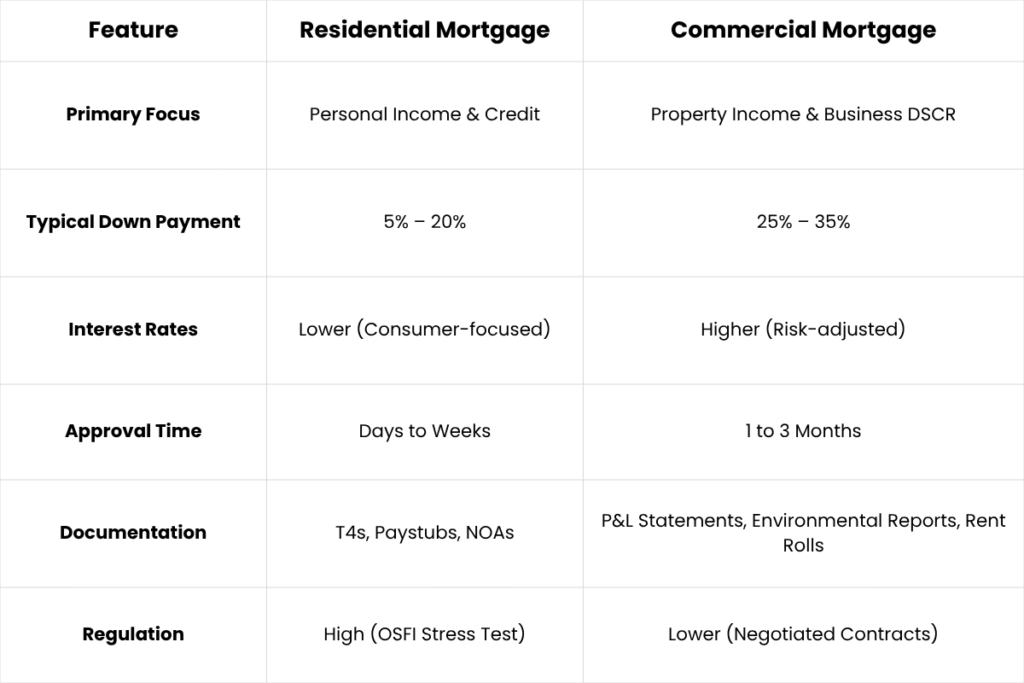
The complexity of the documentation is often the biggest shock to business owners. You’ll need to provide more than just your tax returns; you’ll need a comprehensive look at the asset’s health.
What Affects Your Commercial Mortgage Terms?
Beyond the property itself, your business profile dictates the terms you receive.
- Business Financial Health: Lenders look for “staying power.” A business with consistent retained earnings and a strong balance sheet will command better terms.
- Credit Profile: Both the business’s credit and the personal credit of the directors are scrutinized.
- Property Income Potential: If the building is tenanted, the quality of those tenants (their “covenant”) is vital. A building leased to a national grocery chain is viewed as much safer than one leased to a startup.
- Industry Risk: Certain industries (e.g., hospitality or high-tech manufacturing) are viewed as more volatile by lenders, which can result in shorter terms or higher rates.
How to Get the Best Commercial Mortgage Rates
Securing a competitive rate requires preparation. You aren’t just a borrower; you are a business partner in the eyes of the lender.
- Build a Professional Pro-Forma: Show the lender exactly how the property will pay for itself.
- Improve Your DSCR: If possible, reduce existing business debt before applying to show a higher debt-service capacity.
- Prepare for a Higher Down Payment: The more “skin in the game” you have, the more leverage you have to negotiate a lower rate.
- Use a Specialist: Implementing strategies for securing the best purchase rate often involves shopping the deal to multiple “hidden” lenders that only brokers can access.
Common Mistakes Businesses Make
Avoid these pitfalls to ensure your investment stays profitable:
- Underestimating Closing Costs: Commercial appraisals, environmental assessments (Phase I and II), and legal fees can cost upwards of $10,000 to $20,000+.
- Choosing the Wrong Term Structure: Locking into a 5-year term when you plan to renovate and refinance in 2 years can result in massive prepayment penalties.
- Not Comparing Lenders: Sticking with your everyday business bank might seem convenient, but it can cost you thousands in missed rate opportunities.
Review these common mortgage mistakes brokers help you avoid before starting your application.
Commercial Mortgage Approval Process
The road to mortgage pre-approval for commercial properties is a marathon, not a sprint.
- Initial Consult: Discussing your goals and property type with a broker.
- Letter of Interest (LOI): A lender provides a non-binding summary of the terms they might offer.
- Due Diligence: The lender orders an appraisal, an environmental report, and a building condition assessment.
- Financial Review: A deep dive into your business’s last three years of financial statements.
- Final Commitment: The formal offer of financing.
When Commercial Mortgages Make Sense
Is now the right time to buy? Commercial mortgages are a tool for growth in several scenarios:
- Expanding Your Business: When your current leased space can no longer hold your operations.
- Investing in Real Estate: When you want to build a portfolio of income-producing assets.
- Securing Long-Term Space: To protect your business from skyrocketing rents and the whims of a landlord.
How Mortgage Intelligence Helps Businesses Secure Better Terms
Navigating the Canadian commercial lending market is a full-time job. Our brokers act as your outsourced “Chief Financing Officer,” providing:
- Access to Multiple Lenders: From Big Six banks to private equity funds.
- Tailored Solutions: Customizing terms to match your business’s seasonal cash flow or expansion plans.
- Negotiation Expertise: We speak the lender’s language, ensuring you don’t leave money on the table.
Ready to take the next step? Explore our commercial mortgage solutions in Canada or connect with a mortgage broker near you to get started.
Commercial mortgages are complex, but they are also one of the most powerful tools for building wealth and business stability in Canada. The right structure, balancing rate, term, and amortization, can significantly impact your annual profitability. With the right expert advice, you can ensure that your property becomes an asset that fuels your business, rather than a liability that drains it.
FAQs
- What are commercial mortgage rates in Canada? Commercial rates are typically 0.5% to 2% higher than residential rates. They are determined by the property type, the financial strength of the business, and the current Bank of Canada prime rate.
- How do commercial mortgage terms work? Commercial terms are usually shorter than residential ones, typically ranging from 1 to 5 years. At the end of the term, the balance must be renewed or refinanced.
- What is the typical down payment for commercial property? In most cases, you will need a down payment of 25% to 35% (an LTV of 65% to 75%). For CMHC-insured multi-unit buildings, the down payment can be as low as 15%.
- Are commercial mortgage rates higher than residential? Yes, they are generally higher because commercial real estate is considered a higher risk for lenders. The properties are harder to sell quickly (less liquid) and are more sensitive to economic downturns.
- How long are commercial mortgage terms? Most business owners opt for 3 or 5-year terms, though you can find 1-year bridge terms or longer 10-year terms, depending on the lender.
- Can I get a fixed-rate commercial mortgage? Absolutely. Fixed-rate commercial mortgages are very common and provide businesses with the security of knowing exactly what their debt service costs will be for the duration of the term.