
Prices vary across Toronto, Mississauga, Ottawa, Hamilton, Kitchener-Waterloo, and Durham Region; buyers must also plan for the stress test, closing costs, and ownership expenses. That is why first-time home buyer programs in Ontario should be considered early, not after an offer is accepted.
Help includes rebates, registered savings plans, credits, and local loans. Some lower costs permanently; others make savings available sooner. Start by understanding your budget and home affordability, then review the key considerations before buying your first home, and decide what a program makes possible.
Speak with a Mortgage Intelligence broker to discover which programs you qualify for.
Who Qualifies as a First-Time Home Buyer in Ontario?
Being a first-time home buyer does not always mean you have never owned a home. Eligibility in Ontario depends on the specific program, your homeownership history, and, in some cases, your spouse’s status. Some programs may still consider you eligible if you have not lived in a home owned by you or your spouse within a certain period. Reviewing the requirements of each program can help you understand which benefits, rebates, or incentives may be available to you.
Federal Definition of a First-Time Buyer
For most federal programs, you qualify if you did not live in a home that you or your spouse or common-law partner owned during the current calendar year or the previous four calendar years. Each benefit applies its own detailed test. Special rules may also allow access after a marriage or common-law partnership breaks down.
Ontario’s Stricter Land Transfer Tax Test
You must be at least 18, occupy the home as your principal residence within nine months of the transfer, and never have owned a home or an interest in one anywhere in the world. Spousal ownership can also affect the refund. These rules differ from some first-time home buyer incentives in Ontario.
Why Qualification Matters
One program’s approval does not guarantee another. Eligibility controls access to rebates, credits, savings plans, and local assistance, so review the FAQs every first-time home buyer should know before making an offer.
Why Government Programs Matter in Today’s Ontario Housing Market
Buying a home in Ontario requires careful planning as buyers manage rising prices, strict mortgage qualification rules, and high upfront costs. Government programs can reduce some of these financial pressures through tax savings, rebates, and other forms of support. Understanding what is available early can help buyers create a more realistic path to homeownership.
Rising Home Prices Across Ontario
The challenge is not limited to one city. According to June 2026 Ontario housing statistics, the provincial average resale price was $831,595; the GTA average was $1,058,658. Buyers in Ottawa, Hamilton, Waterloo Region, and Durham face different prices, but the upfront costs remain significant.
Challenges First-Time Buyers Face
Qualification depends on income, debts, property taxes, heating, condominium fees, the stress test, and lender rules. Ontario homebuyer assistance programs may reduce the cash required at closing, but they do not increase the mortgage amount a lender will approve. Compare mortgage rates available today and test the payment against a realistic budget.
Federal Programs Available to Ontario Home Buyers
Federal programs give eligible Ontario buyers several ways to build a down payment and reduce certain purchase costs. Each option works differently, so understanding its limits, tax treatment and repayment rules is important. The following programs can be used individually or combined when eligibility requirements are met.
Home Buyers’ Plan (HBP)
The Home Buyers’ Plan lets an eligible buyer withdraw up to $60,000 from an RRSP to buy or build a qualifying home. Two eligible buyers may each use their limit. This is not a grant; it is normally repaid over 15 years, and a missed annual repayment is generally taxable income. The temporary five-year repayment deferral applied to first withdrawals from 2022 through 2025.
First Home Savings Account (FHSA)
An FHSA provides $8,000 of room in its opening year and a $40,000 lifetime limit. Contributions may be deductible; growth and a qualifying withdrawal are tax-free. It can be paired with the Home Buyers’ Plan. The room begins only after the account is opened, so starting earlier can help.
First-Time Home Buyers’ Tax Credit
An eligible buyer may claim up to $10,000 through the home buyers’ amount, producing a non-refundable federal credit of up to $1,500. The claim may be shared with a spouse or common-law partner, but the combined claim cannot exceed the limit. Although often called a first-time buyer tax credit in Ontario, it is a federal credit available across Canada.
New for 2026: First-Time Home Buyers’ GST/HST Rebate
Applications are open for qualifying new or substantially renovated homes. The federal and Ontario first-time home buyers’ GST/HST rebate can provide up to $50,000 federally and up to $80,000 for Ontario when conditions are met. The federal rebate is fully available for eligible homes up to $1 million and phases out between $1 million and $1.5 million. It does not apply to an ordinary resale home.
Since this rebate applies only to certain homes, buyers should also review the essential first-time buyer programs available in Canada to explore other forms of financial support.
Ontario Land Transfer Tax Rebates for First-Time Buyers
What Is Land Transfer Tax?
Land transfer tax is charged when a property changes hands; the amount is based on the purchase price and is normally due at closing.
First-Time Buyer Rebate Program
Eligible buyers can receive a refund of up to $4,000 to offset the tax on the first $368,000 of a qualifying purchase. Although sometimes grouped with Ontario home buyer grants, this is a tax refund. It is normally claimed when the transfer is registered; check the official land transfer tax refund rules before closing.
Toronto Land Transfer Tax Rebate
Toronto also charges a municipal land transfer tax. An eligible first-time purchaser may receive a separate rebate of up to $4,475. The provincial and municipal rebates can be stacked for combined relief of up to $8,475.
Municipal Home Buyer Programs Worth Exploring
Affordable Home Ownership Programs
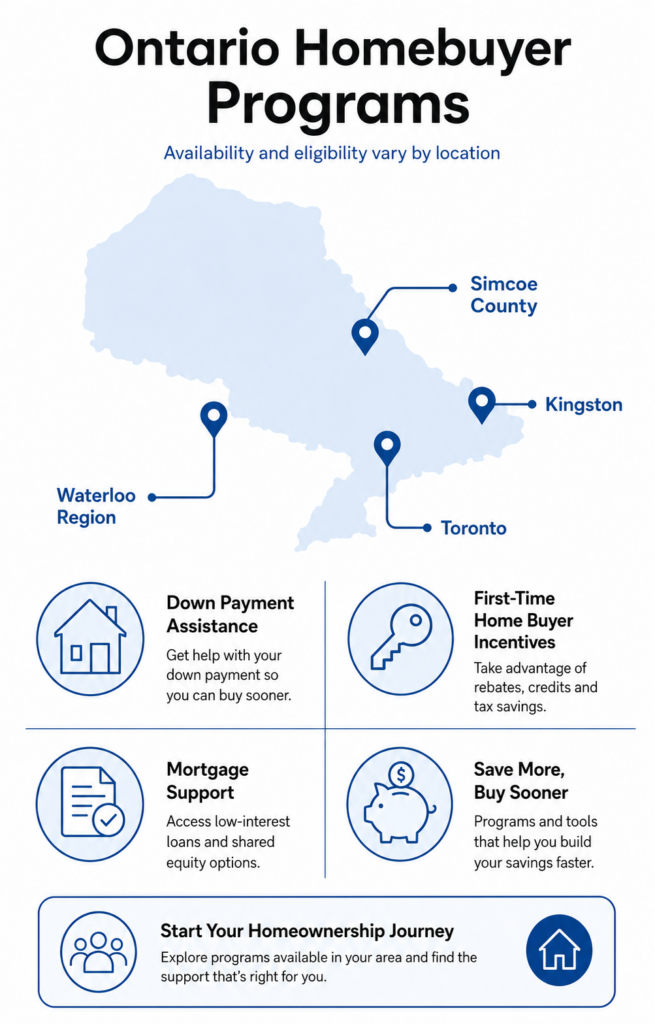
There is no permanent, province-wide down payment grant for every buyer. Some municipalities and regions instead offer targeted affordable home ownership programs for eligible renters.
Down Payment Assistance Programs
Local Ontario down payment assistance programs are often structured as a second mortgage or forgivable loan; income, residency, purchase price, property type, and resale rules apply.
Programs for Moderate-Income Households
- Waterloo Region: Under the eligibility criteria effective April 24, 2026, the Affordable Home Ownership Program provides eligible renters with a five percent down payment loan for homes priced at $620,000 or less. The household income limit is $129,200, and applicants must have lived in Waterloo Region for at least one year.
- Simcoe County: The 2025–2026 Affordable Homeownership Program provides eligible renter households with up to 10% in down payment assistance through a 20-year forgivable loan. Assistance is offered as funding becomes available.
- Kingston and Frontenac County: Applications for the 2026 Home Ownership Program are closed because the program has reached its maximum number of applications given available funding. The program provides eligible households with a forgivable down payment loan.
Why Local Eligibility Matters
These examples show why down payment help in Ontario is location-specific and time-sensitive. Funding can open, close, or change during the year. Contact the local housing department before relying on a program in your financing plan.
How Much Money Could These Programs Save You?
Example Scenario: First-Time Buyer Purchasing a $600,000 Home
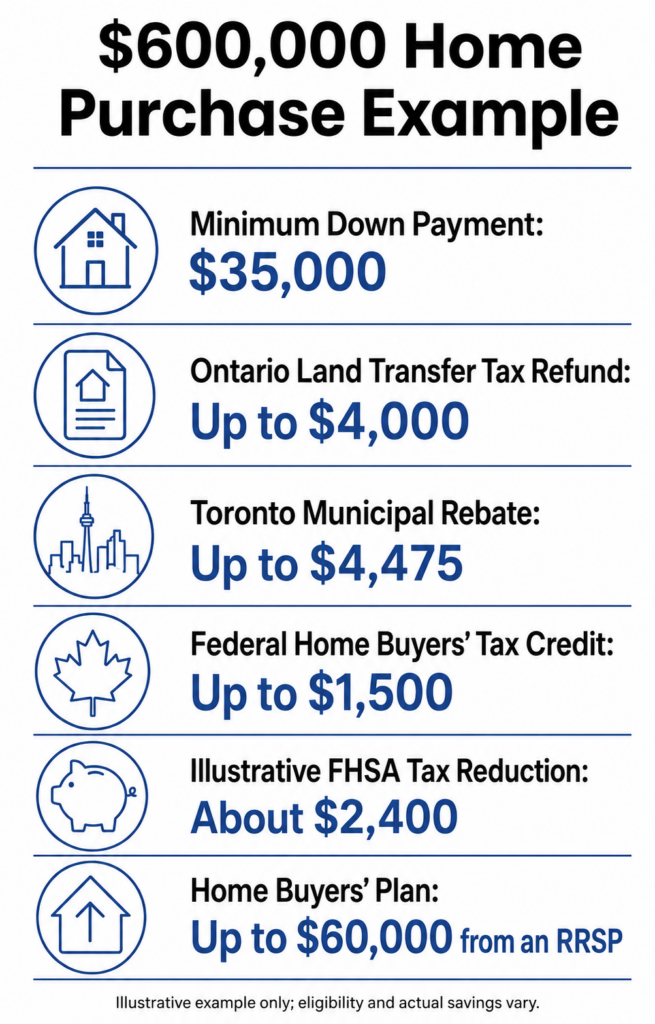
Separate non-repayable benefits from the buyer’s savings. For one eligible buyer purchasing a $600,000 resale home with an insured mortgage, the minimum down payment is $35,000: 5% of the first $500,000, plus 10% of the remaining $100,000.
- Ontario land transfer tax refund: up to $4,000.
- Additional Toronto municipal rebate, if the home is in Toronto: up to $4,475.
- Federal home buyers’ tax credit: up to $1,500, depending on tax payable.
- Illustrative FHSA tax reduction: an $8,000 deductible contribution at a 30% marginal tax rate could reduce income tax by about $2,400; the actual result depends on income and province of residence.
- Home Buyers’ Plan liquidity: up to $60,000 from the buyer’s RRSP; this is the buyer’s own money and must be repaid, so it should not be counted as savings.
This illustration shows about $7,900 in non-repayable relief outside Toronto or $12,375 in Toronto, including the estimated FHSA tax reduction. It is an example, not a quote. Actual mortgage assistance for Ontario buyers depends on eligibility, tax payable, location, and property type; new-home GST/HST relief requires a separate calculation.
Common Mistakes Buyers Make When Using Home Buyer Programs
Home buyer programs can provide valuable support, but small mistakes may delay an application or reduce the assistance available. Each program has its own deadlines, documents, and eligibility rules. Careful preparation can help buyers avoid the following common issues.
Missing Application Deadlines
Municipal funds may be limited, and tax refund applications have filing windows. Confirm dates before relying on assistance in your purchase plan.
Not Understanding Eligibility Rules
Federal and Ontario definitions are not identical. Also, an RRSP withdrawal or repayable local loan is not free money; treating it as a grant can make a purchase look more affordable than it is.
Forgetting About Closing Costs
Legal fees, title insurance, adjustments, moving, inspections, and the unreimbursed portion of land transfer tax still require cash at closing.
Assuming They Don’t Qualify
A previous property or a spouse’s ownership may affect programs differently, so check each definition instead of ruling yourself out.
Before committing to a purchase, review closing costs and additional fees to prepare for expenses beyond the down payment, and avoid home-buying mistakes for practical guidance on financing and planning errors that could delay your purchase or lead to unexpected costs.
Beyond Grants: Other Ways to Improve Affordability
Government assistance is only one part of making homeownership more manageable. Buyers can also strengthen their financial position by improving their mortgage application, increasing savings, and lowering monthly debt. These steps may create more borrowing options and support a more comfortable long-term budget.
Improve Your Credit Score Before Applying
A stronger application creates more options. Protect your payment history, keep credit use low, and avoid new credit before closing.
Increase Your Down Payment
Build savings beyond the minimum down payment so closing costs and early ownership expenses do not drain your reserve.
Reduce Existing Debt
Paying down revolving balances and other debts may improve qualification by lowering the monthly obligations used in debt-service calculations.
Get Pre-Approved Early
Getting pre-approved for a mortgage before house hunting can clarify your price range and identify potential qualification issues early. Prepare your income records, bank statements, identification, and down payment history before applying. Following a Checklist of Documents Needed for Mortgage Approval and reviewing theset ips for first-time residential mortgage applicants can help you submit a complete application and avoid unnecessary delays.
How First-Time Buyers Can Build a Complete Home Buying Strategy
A successful home purchase requires more than choosing a mortgage or applying for financial assistance. Buyers need a clear plan that connects their budget, financing, ongoing expenses, and future goals. The following steps can help create a practical strategy for both purchasing and maintaining a home.
Budgeting for Ownership Costs
Sustainable affordable homeownership in Ontario requires more than qualifying on closing day. Your budget should include the mortgage payment, property taxes, utilities, insurance, maintenance, and condo fees. Accounting for these ongoing expenses is an important part of budgeting for your first mortgage payment, as it shows whether the full cost of homeownership will remain manageable after closing.
Understanding Mortgage Insurance Requirements
If your down payment is below 20%, mortgage default insurance will normally be required. For homes between $500,000 and $1,499,999, the minimum is 5% on the first $500,000 and 10% on the balance; homes at $1.5 million or more are not eligible for insured financing. Learn more about understanding mortgage insurance for new buyers.
Planning for Future Mortgage Renewals
Rates and household needs may change before renewal. Compare prepayment privileges and penalties, not only the advertised rate, and explore mortgage options that fit your goals.
Working with a Mortgage Broker
A broker can connect the budget, program rules, lender options, and renewal plan so each decision supports the next one.
Ontario Housing Programs vs. Other Provinces
How Ontario Compares to British Columbia
British Columbia’s first-time buyer property transfer tax program can save up to $8,000 on an eligible existing home; the full program threshold is $835,000, with a partial exemption below $860,000. The exact calculations are available on the province’s exemption amounts page.
How Ontario Compares to Quebec
Quebec introduced a refundable homeownership credit in 2026 that can refund up to $5,875 of municipal transfer duties. It is reduced above a $750,000 tax base and reaches zero at $1 million.
Why Location-Specific Programs Matter
Ontario’s First-Time Homebuyers’ Land Transfer Tax Refund provides up to $4,000, with Toronto adding its own rebate. Definitions, price thresholds, and occupancy rules differ, so use special mortgage programs by province to compare location-specific support.
How Mortgage Intelligence Helps First-Time Buyers Maximize Available Programs
With several programs offering different benefits and eligibility rules, choosing the right combination can be difficult. Mortgage Intelligence helps buyers understand their options and determine how each program may fit their financial situation. This guidance can make the mortgage process clearer and help buyers use the support available to them effectively.
Identifying Every Program You Qualify For
A broker can review federal, provincial, and municipal eligibility so useful support is not overlooked. This matters because first-home programs in Ontario have different documents, deadlines, and repayment conditions.
Combining Incentives Strategically
FHSA and HBP funds, land transfer tax rebates, tax credits, and local assistance must be coordinated with the buyer’s closing cash and lender requirements.
Accessing Multiple Lenders Through One Application
A broker can use one application as the starting point for comparing offers from multiple lenders, although a lender may request additional documents. Review first-time home buyer mortgage solutions in Ontario to understand the available paths.
Creating a Long-Term Homeownership Plan
Mortgage Intelligence can compare product features and build a plan that still works at renewal. When you are ready, connect with a mortgage broker near you.
Take Advantage of Every Dollar Available
The best program is one you qualify for and can use without weakening your long-term budget. This first-time home buyer in Ontario: 2026 guide brings federal savings tools, tax credits, land transfer tax relief, municipal assistance, and new-home GST/HST rebates into one plan.
Speak with a Mortgage Intelligence mortgage broker today to discover which Ontario first-time buyer programs could help you purchase your home sooner.
Frequently Asked Questions
1. What programs are available for first-time home buyers in Ontario?
Common options include the FHSA, Home Buyers’ Plan, federal home buyers’ amount, Ontario land transfer tax refund, Toronto’s municipal rebate, the new first-time home buyers’ GST/HST rebate for qualifying new homes, and selected municipal down payment programs.
2. Does Ontario offer down payment assistance?
When researching Ontario mortgage grants, first-time buyers should check local programs. Ontario has no universal down payment grant, but some municipalities offer targeted loans or forgivable loans subject to income, price, residency, and funding limits.
3. What is the Ontario land transfer tax rebate?
It is a refund of up to $4,000 for an eligible first-time purchaser. Toronto buyers may also qualify for a separate municipal rebate of up to $4,475.
4. Can I combine the FHSA and Home Buyers’ Plan?
Yes. If you meet the conditions for both programs, you may use a qualifying FHSA withdrawal and an HBP withdrawal for the same home purchase.
5. How much money can first-time buyers save through Ontario programs?
The amount depends on the home, location, income, savings, and eligibility. A Toronto buyer may receive up to $8,475 in combined land transfer tax rebates; an eligible new-home buyer may qualify for much larger GST/HST relief.
6. Do first-time home buyers need mortgage insurance in Ontario?
Usually, yes, when the down payment is below 20%, and the property is eligible for insured financing. The premium depends on the loan-to-value ratio and chosen amortization.
7. What credit score do I need to qualify for first-time buyer programs?
There is no single score for every benefit. Tax programs focus on their own eligibility rules; lenders and municipal assistance programs apply separate credit and underwriting requirements.
8. Should I get pre-approved before applying for home buyer assistance programs?
Yes. Many municipal programs require proof of mortgage pre-approval, and an early review can reveal affordability or document issues before an intake deadline.