
Buying a home in Canada in 2026 is no longer just about finding the lowest price; it’s about location strategy. As the national market undergoes a “crucial reset,” the days of universal, rapid appreciation have been replaced by a fragmented landscape. While some cities are seeing inventory surges and price corrections, others are hitting record-breaking growth.
There are now unique opportunities, dangers, and mortgage considerations in every locale. Buyers who lack these hyper-local insights often find themselves entering a market at the wrong time or with the wrong financing product. Whether you are looking for the lifestyle appeal of Kelowna, the suburban stability of Port Moody, the coastal charm of Victoria, the affordability of Calgary, the urban density of North York, or the explosive growth in Quebec, this guide breaks down the data you need to move forward with confidence.
Expert Tip: Before falling in love with a property, get a mortgage pre-approval to understand exactly how much purchasing power you have in today’s shifting interest rate environment.
Why Location Matters More Than Ever in Today’s Housing Market
In 2026, the “Canadian housing market” doesn’t exist as a single entity. Instead, we are seeing a dramatic divergence between provinces. Interest rates have stabilized near 2.25%, but their impact is felt differently depending on regional supply levels and local economic health.
- Regional Supply vs. Demand: In Ontario and British Columbia, high inventory levels have turned the tide in favour of buyers. Conversely, the Prairies and Quebec are struggling with tighter supply, keeping upward pressure on prices.
- Lifestyle vs. Investment: Post-pandemic migration trends continue to shape demand. Buyers are increasingly prioritizing “livability” and “space-per-dollar,” leading to the rise of secondary markets.
- Economic Tailwinds: From the impact of oil prices in Alberta to the booming tech and manufacturing sectors in Quebec, local economies are the primary drivers of real estate resilience.
For a deeper look at the macro factors, explore how economic trends affect mortgage rates in Ontario.
Kelowna Real Estate Highlights
Market Overview: A Rebalancing Act
Kelowna remains one of Canada’s most desirable “lifestyle” markets, but 2026 has brought a much-needed cooling period. Early-year data show a shift toward a buyer’s market, with sales volumes dipping while inventory grows. This provides a rare window for negotiation that wasn’t possible during the frantic peaks of previous years.
To navigate these shifts, it’s essential to understand the seasonal trends in Kelowna’s housing market and the specific mortgage options for Kelowna buyers.
Who Should Consider Kelowna?
- Lifestyle Buyers: Those seeking proximity to the Okanagan’s world-class vineyards, lakes, and ski hills.
- Remote Workers: Professionals from Vancouver or Calgary looking for a better quality of life without sacrificing amenities.
- Long-term Investors: With the current “buyer’s market” status, investors can find value in townhomes and condos that previously saw bidding wars.
Key Risks & Opportunities
- Tourism Volatility: Condo values may be impacted by short-term rental laws and travel trends.
- Opportunity: The “spring uptick” is still a powerful force; buying in the quieter winter months of 2026 could secure a better long-term ROI.
- Future Insight: Keep an eye on the evolving cost of living and affordability in Kelowna’s housing market to ensure your investment stays sustainable.
Port Moody Real Estate Highlights
Market Positioning: The “City of the Arts” Alternative
Port Moody has matured from a “hidden gem” into a premier suburban alternative to Vancouver. Known for its “Brewery Row” and stunning waterfront parks, it offers a high livability factor that attracts young families and outdoor enthusiasts.
Why Buyers Choose Port Moody
- Transit & Nature: The Evergreen Extension provides a seamless commute to downtown Vancouver, while Rocky Point Park offers immediate access to the outdoors.
- Family-Centric Growth: The city is seeing significant redevelopment, particularly around the SkyTrain stations, creating new key neighbourhoods in Port Moody designed for modern living.
Victoria Real Estate Highlights
Market Characteristics: Coastal Stability
Victoria remains a “firm” market compared to the mainland. In 2026, while sales volume has decreased slightly year-over-year, benchmark prices for single-family homes have remained remarkably stable at around $1.3 million.
Unique Buying Challenges
- Heritage Properties: Many of Victoria’s most sought-after homes are older, requiring specialized inspections and insurance.
- Financing Complexities: Island properties can sometimes face unique appraisal challenges. It is vital to explore financing options in Victoria, specifically tailored for coastal real estate.
- Timing: Understanding seasonal real estate activity in Victoria can help you time your entry to avoid the spring “rush.”
Calgary Real Estate Highlights
The Affordability Advantage
Calgary is currently the star of the Prairies. While Vancouver and Toronto grapple with high entry costs, Calgary offers a more balanced market. The “secret is out,” nevertheless, as the market has remained stable with a 1% appreciation despite decreases in other large cities due to high net migration from other provinces.
Economic Influence & Investment Potential
- The Energy Sector: Higher oil prices in 2026 continue to provide a net positive for Calgary’s economy, shielding it from some of the broader national slowdowns.
- Construction Boom: Calgary is seeing a record number of housing starts. This increase in supply is helping to prevent the runaway price growth seen in 2024-2025.
- ROI: For those looking at investment property mortgage solutions, Calgary’s multi-family segment continues to show strong resilience.
Learn more about specific areas in our Calgary real estate insights.
North York Real Estate Highlights
Urban Market Dynamics
North York is no longer just a suburb; it is a major urban hub within the Toronto ecosystem. The market here is currently cool, with nearly six months of inventory available. This high inventory makes it a prime target for buyers who were previously priced out of the GTA.
Price vs. Value Analysis
- Median Price: As of early 2026, the median sales price in North York sits around $782,000, largely driven by a high volume of condo sales (54% of the market).
- Stability: Despite the “cool” market label, North York is a stable long-term hold due to its proximity to transit and major employment hubs.
Review our North York housing market overview for a breakdown of prices by property type.
Quebec (Montreal & Quebec City) Real Estate Highlights
The 2026 Growth Leader
If you are looking for appreciation, look toward Quebec. While Toronto and Vancouver are forecasting price drops, Quebec City is expected to see a massive 12.0% increase in aggregate home prices in 2026, with Montreal following at a healthy 5.0%.
Unique Considerations
- Affordability: Even with rapid growth, Quebec remains significantly more affordable than the BC or Ontario markets.
- Legal Framework: Buying in Quebec involves a different legal system (Civil Law) and specific Quebec housing prices and options that buyers from out-of-province should study carefully.
Comparing These Markets: Where Do You Get the Best Value?
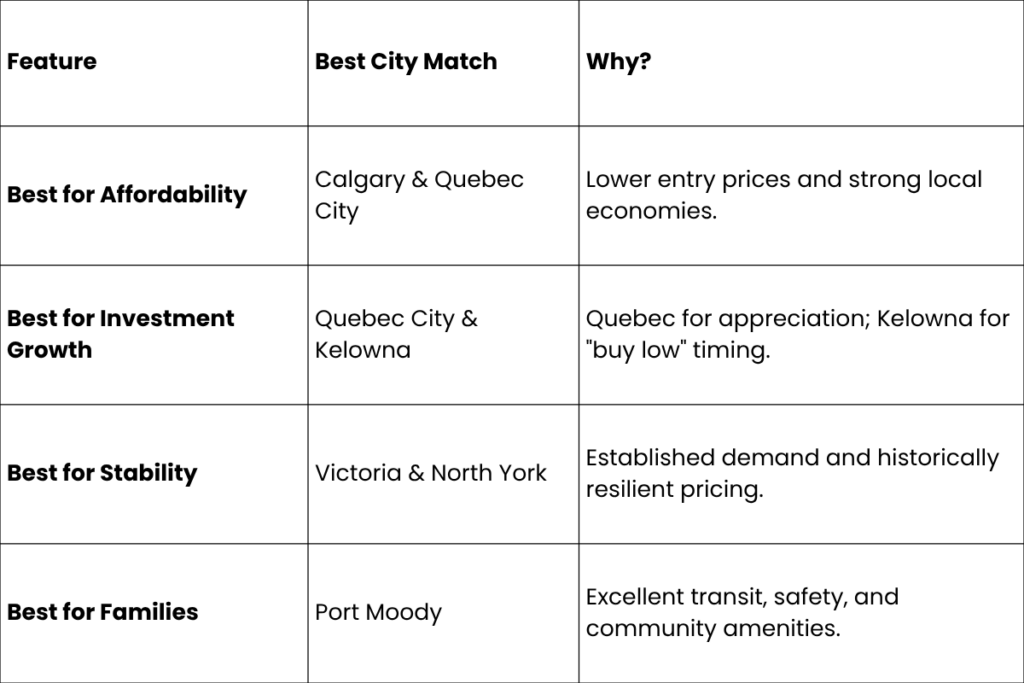
Ready to compare numbers? Check our current mortgage rates to see how your budget fits into these different regions.
How to Choose the Right Market for Your Situation
- Define Your Goal: Are you buying a primary residence or looking for refinancing opportunities on an investment?
- Understand Your Financing: If you are a first-time home buyer or new to Canada, certain markets (like Calgary or North York) may offer more accessible entry points.
- Evaluate Long-Term Growth: Don’t just look at today’s price; look at the 5-year infrastructure and migration plan for the city.
How Mortgage Intelligence Helps You Choose the Right Market
Navigating a landscape as complex as the 2026 Canadian real estate market requires more than just an app; it requires a strategist. At Mortgage Intelligence, we provide:
- Cross-Provincial Expertise: We understand the regional differences between a condo in North York and a lakefront property in Kelowna.
- Personalized Strategy: Whether you need a low-rate variable mortgage or a stable fixed-rate for a 2026 renewal, we match the product to the market.
- Streamlined Access: From pre-approval to closing, we handle the heavy lifting.
Find a mortgage broker near you to get personalized advice based on your specific financial goals.
The 2026 real estate market rewards the patient and the informed. Location impacts everything, from your mortgage approval and interest rates to your long-term ROI. Don’t choose blindly; choose strategically by aligning your lifestyle needs with the economic realities of these diverse Canadian cities.
Ready to take the next step? Speak with a Mortgage Intelligence broker today for a custom analysis of which market is right for you.
FAQs
Which city in Canada is best for real estate investment in 2026?
Quebec City is currently leading the country in projected price appreciation (12%), while Calgary offers strong ROI for rental properties due to population growth.
Is Kelowna a good place to buy property in 2026?
Yes, but strategy is key. 2026 has shifted into a “buyer’s market” in the Okanagan, meaning there is more inventory and more room to negotiate than in previous years.
Is Calgary still affordable for homebuyers?
Compared to Vancouver and Toronto, yes. However, prices are stabilizing upward due to high interprovincial migration, so acting sooner rather than later is advisable.
What is the difference between Quebec and Ontario housing markets?
In 2026, Ontario (specifically the GTA) is seeing a price correction and high inventory, while Quebec is seeing significant price growth and a much tighter supply/demand balance.
Is Port Moody a good alternative to Vancouver?
Absolutely. It offers a similar coastal lifestyle and transit access but with a more community-focused, suburban feel and generally more “value-per-square-foot” than downtown Vancouver.