
Buying a home involves many important decisions, from choosing the right property and neighbourhood to determining how much you can comfortably afford. Yet one factor that can have a significant impact on the long-term cost of homeownership is sometimes overlooked: when you secure your mortgage rate.
Even a seemingly small difference in interest rates can change your monthly mortgage payment and the amount of interest you pay over time. On a large mortgage, a difference of just 0.50 percentage points can add thousands of dollars to borrowing costs within a single five-year term.
That is why securing low mortgage rates is not simply about searching for the lowest advertised number. It is also about understanding market conditions, getting prepared early, comparing lenders, and knowing when to lock in a mortgage rate.
No borrower can predict interest rates perfectly. A better strategy is to understand your options and be ready to act when favourable opportunities arise.
Why Mortgage Rates Matter More Than Most Buyers Realize
A mortgage rate affects much more than your monthly payment because even a small rate difference can influence affordability and borrowing costs for years.
The Long-Term Cost of Interest
Interest is the cost you pay for borrowing money, and the rate attached to your mortgage determines how quickly that cost accumulates.
Consider a $600,000 mortgage amortized over 25 years. At an illustrative rate of 4.50%, the monthly principal-and-interest payment would be approximately $3,321. At 5.00%, it would increase to approximately $3,490. That is roughly $169 more every month.
Over the first five years alone, the higher rate would result in approximately $14,400 more interest being paid, based on these assumptions.
This demonstrates why understanding how to get the lowest mortgage rate available for your circumstances can have a meaningful financial impact.
Monthly Payment Impact
The effect becomes clearer as mortgage balances increase. The following examples assume a 25-year amortization and compare illustrative rates of 4.50% and 5.00%:
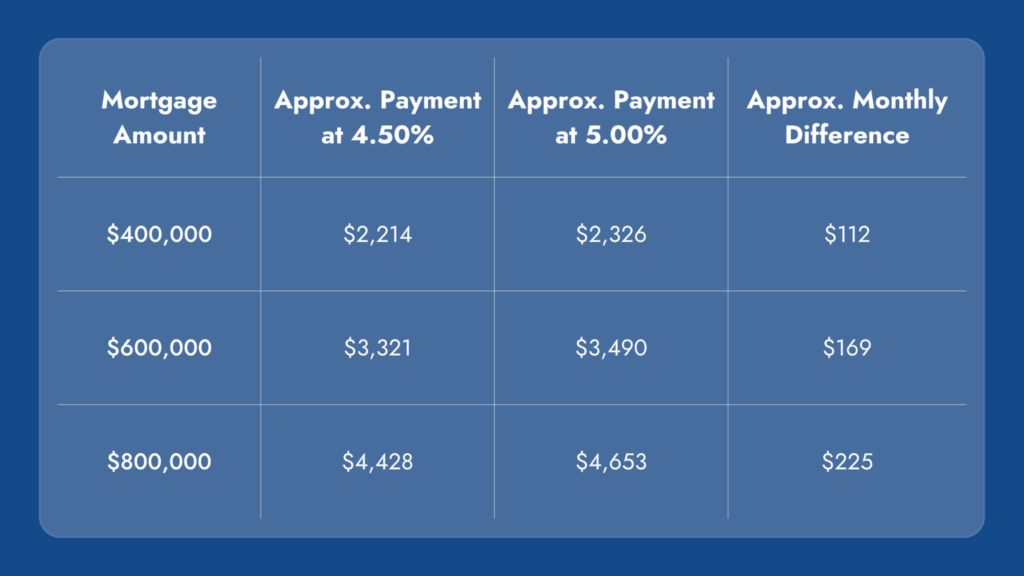
These examples are illustrative and exclude property taxes, insurance, fees, and other housing expenses.
A quarter-point or half-point change may seem modest when you first compare rates, but multiplied across hundreds of thousands of dollars, the difference becomes much more substantial.
Affordability and Borrowing Power
Mortgage rates can also affect how much you qualify to borrow.
Federally regulated lenders generally require borrowers to qualify using Canada’s mortgage stress test. The qualifying rate is typically the greater of 5.25% or the negotiated mortgage rate plus two percentage points, according to the Financial Consumer Agency of Canada (FCAC).
As rates rise, the qualifying payment can increase, potentially reducing borrowing capacity.
Understanding the rate is therefore an important part of determining an appropriate home-buying budget. Review our mortgage comparison guide to find the best option, which can also help you evaluate mortgage options beyond the headline rate.
What Influences Mortgage Rates in Canada?
Understanding the forces behind mortgage rate trends in Canada can help you make more informed decisions without trying to predict every market movement.
Bank of Canada Decisions
The Bank of Canada influences short-term borrowing conditions through its policy interest rate.
When the Bank changes its target for the overnight rate, the move typically affects other interest rates, including lenders’ prime rates. Variable-rate mortgages are particularly sensitive to changes in prime rates.
That does not mean every mortgage rate will move immediately or by exactly the same amount.
Inflation Trends
Inflation is one of the most closely watched economic indicators when considering a mortgage rate forecast in Canada.
The Bank of Canada aims to keep inflation around the 2% midpoint of a 1% to 3% target range. When inflation remains persistently elevated, higher interest rates may be needed to reduce demand. When inflation declines and economic conditions weaken, there may be more room for lower policy rates.
Employment and Economic Growth
Employment, wage growth, consumer demand, and overall economic activity can influence expectations about future monetary policy.
Strong economic data may reduce expectations for near-term rate cuts, while weaker conditions may increase expectations that monetary policy could eventually become more accommodative.
Bond Market Performance
Fixed mortgage rates respond differently from variable rates.
Government of Canada bond yields reflect market expectations about inflation, economic growth, and future interest rates. Movements in bond markets can therefore affect lenders’ funding costs and fixed mortgage pricing.
Because bond yields can change before a Bank of Canada announcement, fixed rates do not always move at the same time as the policy rate. The Bank of Canada publishes benchmark bond yield data through its official rate statistics.
Global Economic Conditions
Canada is also affected by developments outside the country.
Global inflation, trade conditions, financial market volatility, geopolitical events, commodity prices, and interest-rate expectations in other major economies can influence Canadian markets.
Regional economic conditions may matter as well. Buyers can explore our guides to economic trends and their impact on mortgage rates in Ontario and economic factors affecting mortgage rates in Quebec for additional context.
Why Timing Matters When Shopping for a Mortgage
Good mortgage rate timing in Canada is less about calling the exact market bottom and more about avoiding unnecessary exposure to changing conditions.
Rates Can Change Quickly
Mortgage offers are not permanent. Lenders may adjust pricing as bond yields, funding costs, competitive conditions, or monetary policy expectations change. A rate available when you begin searching for a property may not necessarily be available several weeks later.
Delaying Could Increase Costs
Waiting can make sense when you have a specific financial reason to do so, but waiting solely because you expect rates to fall creates uncertainty. If rates rise instead, you may face a higher monthly payment or lower qualifying amount.
That is why the best time to lock in mortgage rates is not necessarily the day rates reach their absolute lowest level. It may be when you have found a competitive mortgage that fits your budget, timeline, and risk tolerance.
Opportunities Often Have Limited Windows
Competitive lender promotions or pricing changes may only be available temporarily. Being financially prepared gives you more flexibility to respond when the right opportunity appears.
Market Sentiment Can Shift Unexpectedly
Economic forecasts change as new information becomes available. A stronger-than-expected inflation report, employment release, or change in global financial conditions can quickly alter expectations for future rates. Instead of relying entirely on headlines, build a financing strategy before you need to make a final decision.
The Role of Mortgage Pre-Approval in Securing Low Rates
Getting prepared early can provide greater certainty when rates and housing-market conditions are changing.
What Is a Rate Hold?
A rate hold allows an eligible borrower to secure a mortgage rate for a specified period while continuing the home-buying process.
Getting a mortgage pre-approved and securing a rate hold can help establish how much you may qualify to borrow and may also provide an opportunity to secure a rate before you have purchased a property.
How Long Rate Holds Typically Last
The FCAC notes that lenders may allow borrowers to lock in an interest rate for approximately 60 to 130 days, depending on the lender.
The exact period, conditions, and rate offered vary.
Ask whether:
- The rate can be reduced if market rates decline before closing.
- The hold applies to the mortgage product you are considering.
- The rate hold can be extended.
- Changes to your application could affect the approval.
Why Pre-Approval Protects Buyers
A mortgage pre-approval rate hold can reduce some of the uncertainty associated with changing rates. If rates rise during the hold period, you may still have access to the secured rate, provided you continue to meet the lender’s conditions. If rates fall, your broker may be able to review whether better pricing is available.
Pre-approval does not guarantee final mortgage approval because the lender still needs to assess the property and confirm that the application meets its requirements.
Benefits During Rising Rate Environments
Rate holds can become particularly useful when borrowing costs are moving higher. Rather than watching rates rise while searching for a property, you may have a defined financing option available while completing your purchase.
Common Situations Where Timing Becomes Critical
Rate timing can matter at several stages of homeownership, not only when purchasing your first property.
First-Time Home Buyers Entering the Market
First-time buyers often have limited experience with changing mortgage rates. Getting pre-approved early can establish a budget, reduce uncertainty, and make it easier to respond when the right property becomes available.
Mortgage Renewals
A mortgage renewal is another important opportunity to review rates. You do not necessarily need to accept your existing lender’s first renewal offer. Reviewing your options ahead of the maturity date can provide more time to compare lenders, terms, features, and rates.
Refinancing Decisions
When refinancing, the lowest new rate does not automatically produce the greatest savings. Existing mortgage penalties, fees, your remaining term, and the purpose of refinancing should all be considered. The FCAC cautions that breaking a mortgage to obtain a lower rate may still cost more once penalties and other fees are included.
Investment Property Purchases
For investors, financing costs directly influence cash flow. Changes in rates can affect monthly carrying costs and the financial performance of a prospective property, making early financing preparation especially important.
Fixed vs. Variable Rates: Does Timing Matter Differently?
Understanding fixed and variable mortgage rates is essential because the two options respond to market conditions differently.
Timing Fixed Rates
Fixed mortgage pricing is influenced by bond market conditions and lenders’ funding costs. Bond yields can move quickly as markets respond to economic information and future interest-rate expectations. Someone watching only Bank of Canada announcement dates could therefore miss important movements in fixed-rate pricing.
Timing Variable Rates
Variable mortgage rates are generally tied to a lender’s prime rate, which is influenced by Bank of Canada policy rate changes.
When the Bank changes the overnight rate, lenders may adjust prime rates, which can then affect borrowers with variable-rate products.
Understanding the Risks of Waiting
Waiting for lower rates may benefit you if rates decline, but there is no guarantee that they will. The better choice depends on your budget, risk tolerance, plans for the property, and ability to absorb payment changes.
For a more detailed comparison, read our guide to fixed vs. variable mortgages to decide the right option for you.
Signs Mortgage Rates May Be Heading Higher
No single economic indicator determines mortgage rates, but several developments can create upward pressure or change market expectations.
Signals Worth Watching
Potential signs include:
- Persistent Inflation: Inflation that remains above expectations can reduce the likelihood of lower policy rates.
- Strong Employment Data: A resilient labour market may indicate continued economic strength.
- Central Bank Commentary: Statements suggesting concern about inflation can influence market expectations.
- Increasing Bond Yields: Rising bond yields may create pressure on fixed mortgage pricing.
- Strong Consumer Spending: Persistent demand can contribute to inflationary pressure.
These are signals, not guarantees. Mortgage decisions should not be based on one economic release alone.
Signs Mortgage Rates May Stabilize or Fall
Changing economic conditions can also create an environment where borrowing costs stabilize or move lower.
Signals Worth Monitoring
These may include:
- Slowing Economic Growth: Reduced economic activity may ease inflationary pressure.
- Lower Inflation: Sustained progress toward the Bank of Canada’s inflation target may reduce the need for restrictive policy.
- Weaker Employment Reports: Softer labour market conditions may indicate reduced economic pressure.
- Declining Bond Yields: Falling yields can improve conditions for fixed mortgage pricing.
A forecast can help provide context, but it should not replace a mortgage strategy based on your individual financial needs.
Strategies to Secure the Best Available Rate
Rather than trying to predict the exact bottom of an interest-rate cycle, focus on practical mortgage rate strategies that improve your options.
Get Pre-Approved Early
Begin the financing process before you are ready to submit an offer. A pre-approval can help establish your budget and potentially secure a rate while you search.
Shop Multiple Lenders
Different lenders may offer different rates, terms, qualification requirements, and mortgage features. The FCAC recommends shopping around before committing because differences between mortgage offers can potentially save borrowers thousands of dollars. You can also compare today’s mortgage rates before making an offer as a starting point.
Work With a Mortgage Broker
A broker can compare available options across multiple lenders instead of limiting the search to one financial institution.
Our guide on how our brokers help you find the right mortgage rates explains how broader lender access can support your mortgage search.
Monitor Market Developments
You do not need to follow every economic report. Instead, pay attention to major Bank of Canada decisions, inflation trends, bond yields, and important economic developments when your purchase or renewal is approaching.
Don’t Focus Only on Interest Rates
The lowest rate is not automatically the best mortgage.
Also consider:
- Prepayment privileges
- Penalties
- Portability
- Fixed or variable structure
- Term length
- Restrictions on refinancing or switching lenders
- Overall flexibility
Explore our strategies for securing the best purchase rate for additional considerations.
Mistakes Buyers Make When Trying to Time the Market
Trying too hard to identify the perfect rate can sometimes create more risk than making a well-prepared decision.
Waiting for the “Perfect” Rate
There is no reliable way to know that a particular rate is the market bottom until after conditions have changed. Waiting indefinitely can also affect your home-buying plans if property prices, inventory, or personal circumstances change.
Ignoring Rate Holds
Buyers sometimes delay pre-approval because they assume they can obtain the same rate later. A rate hold may provide valuable protection while still allowing time to evaluate the market.
Following Headlines Instead of Strategy
Mortgage decisions should reflect your finances rather than daily predictions. Economic headlines can change quickly, while your income, down payment, debt obligations, budget, and long-term plans are more important to the suitability of a mortgage.
Choosing a Mortgage Based Solely on Advertised Rates
Advertised rates may apply only to specific products or borrower profiles. Before deciding, understand the mortgage’s restrictions, penalties, qualification requirements, and flexibility. Explore broader mortgage options and find the right mortgage strategy for your home purchase.
Real-World Examples of Timing Impact
A simple comparison demonstrates why a small rate change can have a significant effect over a mortgage term.
Buyer A Locks In Early
Assume Buyer A needs a $600,000 mortgage with a 25-year amortization and secures an illustrative five-year fixed rate of 4.50%.
Their monthly principal-and-interest payment would be approximately $3,321. During the first five years, approximately $126,029 would be paid in interest.
Buyer B Waits Too Long
Buyer B requires the same $600,000 mortgage but waits before securing financing. If rates increase to 5.00%, the monthly payment becomes approximately $3,490, or about $169 more per month. Over the first five years, approximately $140,423 would be paid in interest.
Five-Year Cost Comparison
The 0.50 percentage-point difference means Buyer B would pay approximately $14,394 more in interest during the first five years, while also carrying a slightly higher remaining mortgage balance at the end of the term.
These numbers are illustrative, but they show why mortgage shopping in Canada should involve both competitive comparison and careful timing.
How We Help You Take Advantage of Market Opportunities
At Mortgage Intelligence, we help you assess mortgage options based on your financial situation, goals, and current market conditions.
1. Rate Monitoring Across Multiple Lenders
Rather than relying on a single lender’s pricing, our brokers can review mortgage products from multiple lending sources and help identify competitive opportunities.
2. Access to Competitive Mortgage Products
Different lenders serve different borrower profiles. We can help compare rates alongside product features, qualification requirements, and restrictions so you can make a more informed decision.
3. Personalized Mortgage Strategies
There is no single ideal mortgage for every borrower. Your income, down payment, credit profile, future plans, tolerance for rate changes, and expected time in the property should all influence your strategy.
4. Ongoing Support During the Buying Process
Mortgage conditions can change between pre-approval and closing. Our brokers can help you review available options throughout the process and understand when acting on a competitive rate may make sense.
Preparation Beats Prediction
The key to securing a competitive mortgage rate is not predicting every movement in the market but being prepared to act when the right opportunity appears.
Interest rates can change because of inflation, economic growth, Bank of Canada decisions, bond markets, and global developments. No borrower can consistently predict all of these factors.
You can, however, control your preparation. Getting pre-approved, understanding rate holds, comparing lenders, reviewing mortgage features, and working with a knowledgeable broker can help reduce uncertainty and improve your ability to respond to changing conditions.
If you are buying, refinancing, or approaching renewal, connect with a Mortgage Intelligence broker to explore competitive rates and build a mortgage strategy aligned with your financial goals.
Frequently Asked Questions
1. When Is the Best Time to Lock In a Mortgage Rate?
The best time depends on your purchase timeline, financial situation, market conditions, and tolerance for rate changes. Rather than waiting for a theoretically perfect rate, consider securing a competitive rate when your financing needs become clear.
2. How Long Do Mortgage Rate Holds Last in Canada?
Rate holds vary by lender. The FCAC notes that mortgage pre-approval rates may be locked in for approximately 60 to 130 days, depending on the lender.
3. Can Mortgage Rates Change After Pre-Approval?
Market rates can change, but an eligible rate hold may protect the rate you secured for the specified period. Always confirm the lender’s conditions and whether you can access a lower rate if pricing improves.
4. Should I Wait for Rates to Drop Before Buying a Home?
Not necessarily. Rates are only one part of the decision. Your budget, housing needs, available inventory, purchase price, down payment, and long-term plans should also influence when you buy.
5. How Do Bank of Canada Decisions Affect Mortgage Rates?
Bank of Canada policy decisions influence short-term interest rates and lenders’ prime rates, making them especially important for variable-rate mortgages. Fixed mortgage rates may respond differently because bond-market conditions also play an important role.
6. What Is the Difference Between Fixed and Variable Rate Timing?
Fixed rates are influenced by bond-market expectations and funding costs, while variable mortgage rates are generally linked to lenders’ prime rates. As a result, the two types of rates may move at different times.
7. How Much Can Timing Affect My Mortgage Payments?
The impact depends on your mortgage balance and rate difference. In the examples above, a 0.50 percentage-point increase added approximately $112 per month on a $400,000 mortgage, $169 on a $600,000 mortgage, and $225 on an $800,000 mortgage using a 25-year amortization.
8. Is It Possible to Predict Future Mortgage Rates Accurately?
No forecast can consistently predict mortgage rates with certainty. Economic data, inflation, bond markets, Bank of Canada decisions, and unexpected global events can all change the outlook. Preparation and flexibility are generally more useful than trying to identify the exact market bottom.