
Your home is more than just a sanctuary; it is likely the most significant financial asset you own. For many Canadian homeowners, the bricks and mortar of their residence represent a “forced savings account” that grows more valuable with every mortgage payment and every uptick in the real estate market.
When you find yourself needing significant capital, whether to breathe life into a kitchen renovation, consolidate high-interest debt, or fund a child’s education, that built-up value is often the first place you should look. However, the path to accessing that wealth isn’t a one-size-fits-all solution. Many homeowners find themselves at a crossroads, asking: Should I use a HELOC or a home equity loan?
Choosing the wrong product can lead to unnecessary costs, increased financial risk, or a lack of the very flexibility you needed in the first place. This guide is designed to dismantle the complexity of the Canadian lending landscape, helping you align your equity-borrowing strategy with your long-term financial health.
What Is Home Equity? (The Foundation)
Before diving into the “how” of borrowing, it is essential to understand the “what.” Home equity is the difference between the current market value of your property and the remaining balance on your mortgage and any other liens on the property.
As an example, if your home is currently valued at $800,000 and you owe $450,000 on your mortgage, you have $350,000 in equity. In Canada, federal regulations typically allow you to borrow up to 80% of your home’s appraised value (minus your existing mortgage balance). Equity builds in two primary ways:
- Amortization: Every month, a portion of your mortgage payment goes toward the principal.
- Market Appreciation: If property values in your neighbourhood rise, your equity increases without you spending a dime.
Understanding your equity position is the first step in using financial tools to support your mortgage decision.
What Is a HELOC (Home Equity Line of Credit)?
A Home Equity Line of Credit (HELOC) is a revolving credit facility secured against your home. Think of it as a credit card backed by your property’s equity. You’re approved for a maximum limit, and you can borrow, repay, and borrow again as many times as you like, up to that limit.
How HELOC works:
- A revolving credit structure, you only use what you need, when you need it
- A variable interest rate, typically tied to the lender’s prime rate plus a small spread
- Interest-only payment options during the draw period, which keep minimum payments low
- Flexible repayment, you can pay down your balance at any time without penalty
- Access to funds through online banking, cheque, or a dedicated card
Because interest accrues only on the amount you actually draw, not the full approved limit, a HELOC can be a cost-efficient tool when used with discipline. However, that same flexibility can become a liability without a clear repayment plan.
What Is a Home Equity Loan?
A second mortgage, sometimes known as a home equity loan, operates differently. Rather than giving you a revolving credit line, it provides a single lump-sum disbursement that you repay over a fixed term with regular, scheduled payments.
Key characteristics of a home equity loan in Canada include:
- A one-time lump sum is deposited into your account at the time of funding
- An interest rate that is set and remains constant throughout the term
- Fixed monthly payments that cover both principal and interest
- A defined repayment schedule, typically 1 to 25 years, depending on the lender
- Predictable total borrowing costs from the outset
A home equity loan is structured very much like a traditional mortgage. You know exactly what you’re borrowing, what you’ll pay each month, and when the loan will be fully repaid. That predictability is its greatest strength.
Key Differences Between HELOC and Home Equity Loan
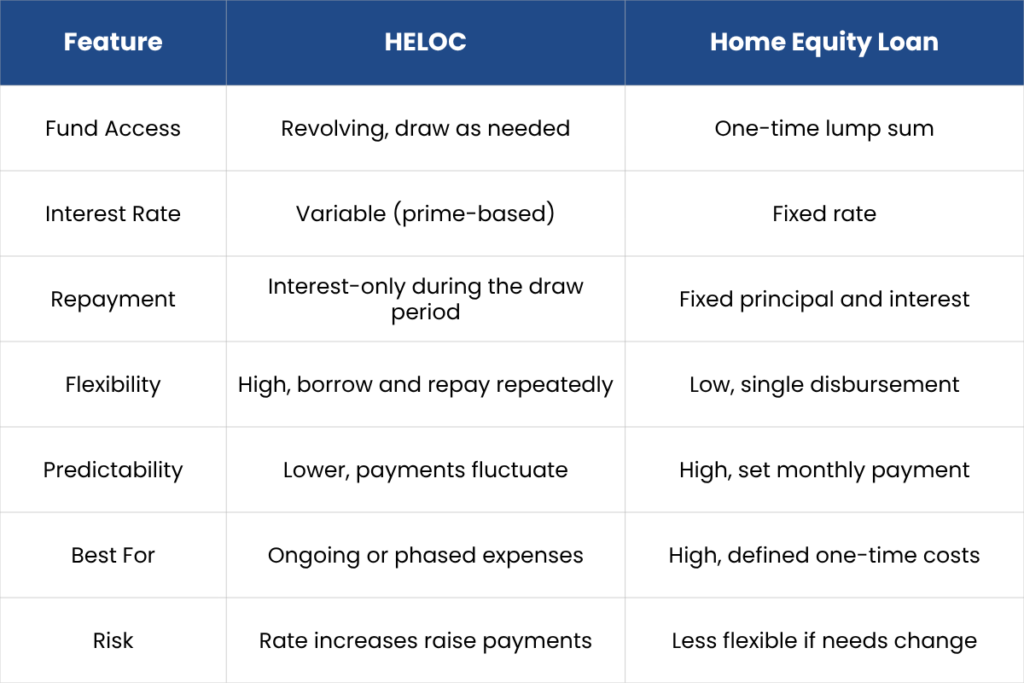
Navigating the HELOC and home equity loan differences in Canada requires a side-by-side comparison of how they impact your wallet and your lifestyle.
1. Access to Funds
The primary differentiator is how you get your money.
- HELOC: Offers “as-needed” access. It is ideal for projects where costs are uncertain or spread out over time.
- Home Equity Loan: Provides a “lump sum.” This is best when you know exactly how much you need to pay for a specific event or purchase.
2. Interest Rates
In the Canadian market, HELOC interest rates are almost exclusively variable. This means if the Bank of Canada raises its policy rate, your borrowing costs go up immediately. A home equity loan often offers the stability of a fixed rate, protecting you from market volatility.
3. Repayment Structure
There are two sides to a HELOC’s flexibility. While interest-only payments are great for short-term cash flow, they don’t reduce your debt. Home equity loans are “self-amortizing,” meaning that by the end of the term, the debt is fully paid off.
4. Flexibility vs. Stability
A HELOC is built for flexibility. A home equity loan is built for stability. Neither is inherently better; the right choice depends entirely on what you’re trying to accomplish and how you manage credit.
When a HELOC Is the Better Option
A HELOC is often the superior choice for Canadians who value agility. It is the best “safety net” or “project fund” available.
- Phased Home Renovations: You can use HELOC for renovations. If you are doing a basement renovation over six months, you can pay contractors in stages without paying interest on the full project cost from Day 1.
- Investment Opportunities: Savvy investors use HELOCs to pounce on opportunities (like a down payment on a rental property) as soon as they arise.
- Emergency Buffer: Having an open HELOC provides peace of mind for unexpected life events, such as job loss or major home repairs.
When a Home Equity Loan Makes More Sense
If you are a borrower who values sleep-at-night certainty, the home equity loan is likely your best path.
- Debt Consolidation: If you are moving $50,000 of high-interest credit card debt into a lower-interest home-secured product, you want a fixed repayment schedule to ensure that the debt actually disappears.
- Large, Fixed Expenses: If you are buying a second property or paying for a wedding, and you know the exact cost, a lump sum is cleaner and easier to manage.
- Budget-Conscious Households: If a $200 increase in your monthly interest payment would strain your finances, the fixed-rate nature of a home equity loan is a vital safeguard.
Risks of Each Option
Let’s go over risk considerations for each mortgage type.
HELOC Risks: The “Evergreen” Debt Trap
The flexibility that makes a HELOC attractive also introduces risks that borrowers should understand clearly:
- Variable rate exposure: If interest rates rise significantly, your monthly payments can increase substantially, sometimes beyond what you budgeted for.
- Overspending risk: Because funds are revolving and easily accessible, it can be tempting to draw more than you need or to use the credit for non-essential purchases.
- Extended debt: Without a structured repayment schedule, some borrowers find their HELOC balance persists for years with minimal principal reduction.
- Lender call provisions: In rare circumstances, lenders can reduce or freeze a HELOC limit if your property value drops or your financial profile changes.
Home Equity Loan Risks: Lack of Liquidity
The fixed-rate home equity loan is generally seen as lower risk, but a home equity loan comes with its own risks:
- Less flexibility: If your financial needs change after funding, you’re locked into the original amount and structure.
- Higher initial payments: Because you’re repaying principal from day one, monthly payments are higher than HELOC interest-only minimums.
- Prepayment penalties: Some lenders charge fees if you pay off the loan early, reducing the benefit of making lump-sum payments.
Using Home Equity Strategically
When used correctly, home equity is a ladder to greater wealth. Many Canadians use mortgage refinancing to access their home equity to achieve three specific goals:
- Debt Consolidation: Rolling 20% interest credit cards into a 6% equity product can save you thousands in interest and improve your credit score.
- Home Improvements: Investing in your home (kitchens, bathrooms, legal suites) often yields a high ROI, effectively using your equity to create more equity.
- Investing: Some homeowners use equity to invest in the stock market or other ventures (often referred to as the Smith Maneuver in Canada), though this requires professional tax advice.
To understand how these choices align with your lifestyle, explore how financial goals influence your mortgage choice.
HELOC vs. Refinancing: What’s the Difference?
A common point of confusion is whether to get a HELOC/home equity loan or simply refinance the first mortgage.
- Refinancing: You break your existing mortgage and replace it with a new, larger one. This is great if current interest rates are lower than your original rate.
- HELOC/Home Equity Loan: These sit “behind” your existing mortgage as a second charge. They allow you to keep your current mortgage (and its low rate) while accessing extra cash.
Choosing between these options depends on your current mortgage terms and potential penalties.
How to Choose the Right Option Based on Your Situation
Ask yourself these three questions to narrow down your choice:
1. Short-Term vs. Long-Term Needs
Do you need the money for a one-month bridge or a ten-year plan? Short-term needs usually favour the HELOC; long-term structural debt favours the loan.
2. What Is Your Risk Tolerance?
Are you okay with your interest rate changing tomorrow morning? If the news of a Bank of Canada rate hike makes you anxious, choose the stability of a fixed-rate home equity loan.
3. Do You Have the Discipline to Pay It Back?
Without a forced repayment schedule, a HELOC can become a permanent debt. If you aren’t disciplined enough to set your own repayment schedule, a structured loan is “safer” for your financial future.
Common Mistakes Homeowners Make
Even the most well-meaning homeowners can stumble. To avoid common mortgage mistakes, watch out for:
- Focusing Only on the Rate: A lower rate on a HELOC doesn’t help if you only pay the interest and never touch the principal.
- Overleveraging: Just because you can borrow up to 80% doesn’t mean you should. Leave some equity as a cushion for market downturns.
- Ignoring Fees: Appraisals, legal fees, and title insurance apply to both products. Factor these “closing costs” into your math.
How Mortgage Intelligence Helps You Use Your Equity Wisely
The Canadian mortgage market is vast, and the big banks aren’t your only option. At Mortgage Intelligence, we act as your personal financial advocates.
Our brokers provide:
- Personalized Analysis: We look at your total financial picture, not just your home value.
- Access to Multiple Lenders: We compare products from big banks, credit unions, and alternative lenders to find the best mortgage options for your situation.
- Strategic Advice: Our brokers help find the right mortgage rates and understand their long-term impact.
If you need to find out HELOC and home equity solutions tailored to your needs or want to get support with mortgage pre-approval, we guide you through every step.
At the end of the day, the choice between a HELOC and a home equity loan comes down to a simple trade-off: flexibility vs. predictability.
- Choose a HELOC if you want a tool that grows and shrinks with your needs, and you are comfortable managing your own repayment.
- Choose a Home Equity Loan if you want the peace of mind that comes with a fixed end date and a steady, unchanging monthly payment.
Your home equity is a hard-earned reward for your years of homeownership. Using it wisely can propel you toward your financial goals, but only if you have the right strategy in place.
Ready to unlock your home’s potential? Connect with a Mortgage Intelligence broker near you for expert advice tailored to the Canadian market.
FAQs
What is the difference between a HELOC and a home equity loan in Canada?
A HELOC is a revolving line of credit where you can borrow, pay back, and re-borrow money as needed. A home equity loan is a one-time lump sum payment with a fixed repayment schedule.
Which is better: HELOC or home equity loan?
Neither is “better” in a vacuum. A HELOC is better for ongoing or uncertain costs (like renovations), while a home equity loan is better for large, one-time expenses where you want a fixed interest rate and a clear “end date” for the debt.
Are HELOC rates higher than home equity loans?
Generally, HELOC rates are slightly higher than first-mortgage rates but lower than unsecured credit cards. Home equity loan rates can be higher or lower than HELOCs, depending on whether you choose a fixed or variable term and the current economic climate.
Can I use a HELOC to consolidate debt?
Yes, this is a very common use. However, because HELOCs often allow interest-only payments, you must be disciplined enough to pay down the principal, or you will never actually clear the debt.
Is a home equity loan safer than a HELOC?
In terms of budgeting, yes. Because the interest rate and payments are fixed, you are protected from “payment shock” if interest rates rise.
How much equity do I need to qualify?
In Canada, you generally need at least 20% equity in your home (meaning your total borrowing cannot exceed 80% of the home’s value). For a standalone HELOC, lenders often require even more “skin in the game.”