
Being self-employed in Canada offers a level of professional freedom and financial upside that traditional employment rarely matches. Whether you are a freelance consultant in Toronto, a tradesperson in Calgary, or a tech entrepreneur in Vancouver, the ability to steer your own ship is rewarding. However, when it’s time to transition from building a business to buying a home, many entrepreneurs encounter a frustrating reality: the Canadian mortgage market is largely built for those with a predictable T4 slip.
With the Bank of Canada maintaining a policy rate of approximately 2.25% and a heightened focus on the “stress test,” self-employed borrowers often find themselves under a microscope. While salaried employees might breeze through with a few recent pay stubs, business owners face a steeper climb involving years of financial history and rigorous income scrutiny.
The good news is that being your own boss does not disqualify you from homeownership. By understanding the common roadblocks and preparing a strategic mortgage pre-approval for self-employed borrowers, you can navigate the system successfully.
Why Self-Employed Borrowers Face More Challenges
Lenders generally prioritize one thing above all else: stability. In the eyes of a traditional financial institution, a salaried employee represents a predictable stream of income. In contrast, self-employed income is viewed as inherently more volatile. This perceived risk leads to stricter documentation requirements and more conservative income calculations.
Furthermore, recent regulatory shifts in 2026 have tightened the screws on debt-to-income ratios. Major banks have become increasingly forensic in their review of self-employed files, often requiring more extensive historical data than in previous years. To ensure you don’t hit a dead end, it is vital to follow a step-by-step guide to our mortgage process so you know exactly what to expect before you start house hunting.
Hurdle #1: Difficulty Proving Income
The most significant barrier for most entrepreneurs is simply proving how much they actually earn. Unlike a standard salary, business income often flows through various channels and fluctuates based on market demand.
Inconsistent Income Patterns
Lenders love consistency. If your business had a record-breaking year in 2024 but saw a dip in 2025 due to expansion costs or market shifts, a lender may focus on the lower number or average the two years. For seasonal workers or those in commission-heavy roles, this “income smoothing” can result in a lower qualifying amount than what you know you can afford.
Lower Declared Income Due to Tax Strategies
As a business owner, you likely work with an accountant to maximize legal tax deductions. While this is excellent for your bottom line, it can be detrimental to your mortgage application. Lenders typically look at your “Line 15000” (Total Income) on your Notice of Assessment (NOA). If you have successfully written off significant expenses to reduce your tax burden, your “paper income” might look too low to support a large mortgage. This dilemma of low-income declared mortgages in Canada is one of the most common reasons for rejection at traditional banks.
Hurdle #2: Strict Documentation Requirements
If you are self-employed, “full documentation” takes on a whole new meaning. Lenders in 2026 often require a minimum of two to three years of consistent financial history. This typically includes:
- T1 General Tax Returns: A complete set for the past two years.
- Notices of Assessment (NOAs): These must show that you have no outstanding balance with the Canada Revenue Agency (CRA). Any taxes owed will usually need to be paid in full before an approval is granted.
- Business Financial Statements: For incorporated businesses, you may need to provide accountant-prepared (CPA) financial statements, including balance sheets and profit and loss statements.
- Proof of Business Ownership: Articles of incorporation or a business licence.
Staying organized is key. If you are missing even one year of NOAs, your application could be stalled indefinitely.
Hurdle #3: Lower Borrowing Power
When a bank calculates your borrowing power, they use specific ratios: the Gross Debt Service (GDS) and Total Debt Service (TDS) ratios. In 2026, many lenders have tightened these requirements, often looking for a TDS ratio of 44% or lower.
Because self-employed income is often “shaved down” by lenders to account for potential volatility, you may find that you qualify for a significantly smaller loan than a salaried peer with the same gross revenue. This is where financial tools become invaluable, allowing you to run various scenarios before you commit to a purchase.
Hurdle #4: Higher Down Payment Expectations
While it is technically possible for some self-employed individuals to qualify for a mortgage with as little as 5% or 10% down through programs like Sagen’s “Business for Self” (Alt-A), these often come with high insurance premiums and very strict income reasonability tests.
More often, self-employed borrowers are encouraged or required to provide a down payment of 20% or more. This is especially true if you are looking for alternative lenders or “stated income” programs where the lender relies on your business bank statements rather than tax returns. A larger down payment acts as a “buffer” for the lender, mitigating the risk of your fluctuating income.
Hurdle #5: Credit Score Sensitivity
In the current market, your credit score carries more weight than ever. For a conventional mortgage, many lenders now look for a score of 680 or higher. If you are self-employed, a lower credit score combined with non-traditional income is often a “double strike” that leads to an automatic decline.
Lenders view a high credit score as evidence of your personal financial discipline. If you can show that you manage your personal debts perfectly despite the ups and downs of business ownership, you are far more likely to see a self-employed home loan approval. If your score isn’t quite there yet, focusing on credit improvement strategies for mortgage approval should be your priority.
Hurdle #6: Limited Access to Traditional Lenders
Canada’s “Big Five” banks have the most rigid “box” for applicants to fit into. If your business structure is complex or your income doesn’t look perfect on paper, you may find their doors closed.
This leads many to seek out alternative lenders for flexible mortgage approval. These “B-Lenders” and Mortgage Investment Corporations (MICs) are more comfortable with the nuances of entrepreneurship. They may charge a slightly higher interest rate or a one-time lender fee, but they offer the flexibility needed to get you into a home when the traditional route fails.
How to Overcome These Hurdles
The obstacles may seem daunting, but thousands of self-employed Canadians successfully secure mortgages every month. The secret lies in preparation and professional advocacy.
Work with a Mortgage Broker
This is perhaps the single most important step. Unlike a bank representative who can only offer one set of products, a broker has access to dozens of lenders. They know which lenders are “self-employed friendly” and how to package your application to highlight your strengths. You can connect with a mortgage broker near you to get an honest assessment of your situation.
Improve Financial Documentation
Don’t wait until you find your dream home to start digging through files. Ensure your business and personal bank accounts are strictly separated. Lenders in 2026 often want to see 12 to 24 months of business bank statements to verify that the revenue you claim is actually flowing through your accounts. Consistent monthly deposits are a major plus in the eyes of an underwriter.
Strengthen Your Credit Profile
Six months before you apply, audit your credit. Pay down revolving debt (like credit cards) to below 30% of their limit and ensure every single bill is paid on time. Even a single 30-day late payment on a car loan can complicate a self-employed mortgage scenario.
Increase Your Down Payment
If you are struggling with income verification, a larger down payment is your best leverage. If you can reach the 20% to 35% threshold, many more doors open via alternative and private lending channels that focus more on equity and business viability than on your personal NOAs.
Mortgage Options for Self-Employed Borrowers
Depending on how you document your income, you generally fall into one of two categories:
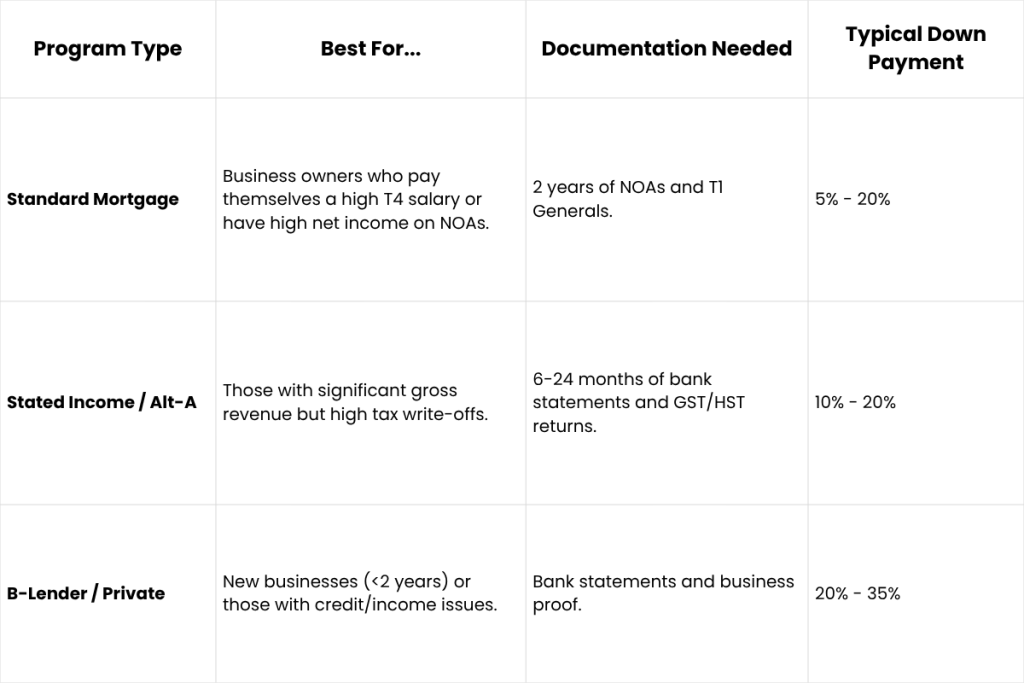
Exploring these self-employed mortgages with a professional can help you decide which path offers the best balance of interest rates and flexibility.
Common Mistakes Self-Employed Applicants Make
Many of the problems self-employed borrowers face in mortgage applications can be traced back to avoidable errors:
- Not Preparing Years in Advance: If you know you want to buy a home in two years, you may want to talk to your accountant about declaring slightly more income now to help with qualification later.
- Taking on New Debt: Buying a new truck for the business or opening a new line of credit right before a mortgage application can ruin your debt-service ratios.
- Ignoring the CRA: Lenders will not touch an application if you owe back taxes. Ensure your GST/HST and personal taxes are up to date and paid.
- Going It Alone: Walking into your local bank branch and hoping for the best is a common way to get a “no.” Expert broker support ensures you are presented to the right lender the first time, helping you avoid mortgage mistakes that could haunt your credit file.
How Professional Guidance Makes a Difference
Securing a mortgage for the self-employed is not about finding a loophole; it’s about telling your financial story in a language that lenders understand. While a bank’s computer might flag your fluctuating income as a “risk,” a seasoned broker sees it as the growth of a successful enterprise.
By using a mortgage comparison guide, you can see how different lenders treat self-employed income, ensuring you don’t settle for a high-rate option when a more competitive one is available. Whether you’re a first-time buyer needing mortgage tips or a seasoned investor, the right strategy makes homeownership a reality.
The path to getting a mortgage for a self-employed individual is certainly more complex than it is for the average employee, but it is far from impossible. By organizing your documentation, maintaining a strong credit profile, and understanding the specialized products available to you, you can overcome the hurdles that often stop others in their tracks.
Your business is a testament to your hard work and vision; your home should be, too. Don’t let paperwork stand in the way of your milestones.
Ready to see what you qualify for? Our experts specialize in navigating the complexities of self-employed financing. We work with a vast network of traditional and alternative lenders to find the perfect fit for your unique business structure. Opt for self-employed mortgage solutions in Canada.
FAQs
- Is it harder to get a mortgage if you’re self-employed in Canada? It is not necessarily “harder,” but it does require significantly more documentation. Because your income isn’t guaranteed by an employer, lenders perform a much deeper dive into your financial history.
- How do lenders verify income for self-employed borrowers? They primarily use your T1 General tax returns and Notices of Assessment (NOAs) for the last two years. Many also now require 12 to 24 months of business bank statements to confirm the cash flow supports the declared income.
- What documents are required for self-employed mortgages? Expect to provide two years of NOAs, T1 Generals, your business licence or articles of incorporation, and often 6 to 12 months of GST/HST returns or bank statements.
- Can I qualify with low declared income? Yes, but you may need to look at “stated income” programs or alternative lenders. These programs allow you to declare a reasonable income for your industry, though they often require a larger down payment (20%+) and higher credit scores.
- Do self-employed borrowers need a larger down payment? Not always. With strong credit and a stable income history, you can qualify with as little as 5% or 10% down. However, if your income is difficult to prove or you are using an alternative lender, a 20% to 35% down payment is common.
- What are the best mortgage options for self-employed individuals? The “best” option depends on your tax strategy. If you show high net income, a traditional bank is best. If you maximize write-offs, an Alt-A lender or a B-Lender using bank statement programs will likely be your most successful route.