
Home equity is the portion of your property that you own after subtracting the debt secured against it. As your mortgage principal falls, or your property’s value rises, that equity may become a useful financial resource. However, equity is not cash sitting in an account; accessing it means taking on debt that must be repaid.
A home equity line of credit (HELOC) allows an eligible homeowner to borrow against their home equity without selling the property. The credit can be used gradually, which may suit expenses that arrive in stages. Before applying, it is important to understand the lender’s approval process, the cost of carrying a balance, and how new borrowing may affect your broader plan to secure financing.
Homeowners commonly consider a HELOC for:
- Home renovations or urgent repairs
- Consolidating higher interest debt
- Education or other major planned costs
- An investment with a clear risk assessment
- A temporary emergency expense
- A down payment on another property
This guide explains how HELOC works in practical terms, how lenders estimate borrowing capacity, and when another form of home equity financing may be more suitable.
What Is a HELOC?
A HELOC is a revolving line of credit secured by a residential property. The lender sets a credit limit; the homeowner may withdraw funds, repay them, and borrow again while the account remains open and in good standing.
Unlike a traditional instalment loan, a HELOC does not normally provide one fixed lump sum followed by a predetermined principal and interest schedule. Interest is charged only on the amount actually withdrawn. If a homeowner has a $75,000 limit but uses $18,000, interest is calculated on the $18,000 balance rather than the full limit.
There are two common structures:
- A standalone HELOC operates separately from the mortgage; its limit does not automatically increase as mortgage principal is repaid.
- A HELOC combined with a mortgage is sometimes called a readvanceable mortgage; available line of credit room may increase as the mortgage principal declines, subject to the agreement and lending limits.
A HELOC is also different from a home equity loan in Canada. A home equity loan usually advances one amount and requires scheduled principal and interest payments. Homeowners who want access to equity but do not want an open revolving balance may prefer that predictability.
Other products serve different stages of homeownership. Someone who does not yet own a property may need first-time home buyer financing rather than a HELOC. Older homeowners seeking funds without regular loan payments may wish to compare reverse mortgages, while considering their distinct costs and eligibility rules.
How Does a HELOC Work?
The process starts with the equity in the property, but approval depends on more than the home’s estimated value. A lender also reviews the applicant’s income, debts, credit history, and ability to manage the proposed limit.
- Building Home Equity
Home equity is calculated by subtracting all debt secured against the property from its current value:
Home value − outstanding mortgage and other secured debt = home equity
For example, a home valued at $700,000 with a $430,000 mortgage has $270,000 in gross equity. That figure does not mean the homeowner can borrow the full $270,000. The lender still applies loan-to-value limits, qualification standards, and its own product rules.
Equity may increase as regular mortgage payments reduce principal. It may also rise if the property appreciates, although market values can move in either direction and the lender may rely on a formal appraisal rather than the owner’s estimate.
- Applying for a HELOC
The lender reviews the property and the applicant’s finances. The process may include:
- A credit check
- Proof of income and employment
- Current mortgage statements
- Details of other debts and monthly obligations
- A property appraisal
- Legal work to register the lender’s interest against the property
The review resembles parts of a mortgage application, but a purchase mortgage pre-approval is not the same as final HELOC approval. Homeowners preparing for another purchase can also review why pre-approval matters and how to get it before assuming that an unused credit limit will improve their buying power.
- Accessing Funds
Once the account is active, funds may be available through online banking, transfers, cheques, a linked card, or another method offered by the lender. This flexibility lets the borrower withdraw only what is needed instead of paying interest on a larger lump sum from the first day.
Interest generally starts as soon as money is withdrawn. Because most HELOC rates are variable, the cost can change even if the balance stays the same.
- Repaying the Borrowed Amount
The agreement sets the minimum payment. Some products allow a payment that covers only the monthly interest; others require interest plus part of the principal. Paying only interest keeps the account current but does not reduce the amount owed.
Principal payments restore available credit, up to the approved limit. A borrower with a $20,000 balance who repays $5,000 would normally regain $5,000 of borrowing room, assuming there are no holds or changes to the account.
How Much Can You Borrow With a HELOC?
The approved limit reflects both the property’s lending value and the borrower’s ability to repay. A large amount of equity can support an application, but it does not override weak income, high existing debt or lender concerns about the property.
The Financial Consumer Agency of Canada’s (FCAC) HELOC guidance states that a HELOC may allow borrowing of up to 65% of a home’s value. It also notes minimum equity of more than 35% for a standalone HELOC and 20% for a HELOC combined with a mortgage. Applicants seeking a HELOC from a bank must also pass a stress test.
Lenders commonly consider:
- The appraised value or acceptable purchase value of the home
- The mortgage balance and any other debt registered against the property
- Household income and its stability
- Credit history and current credit obligations
- Gross debt service and total debt service ratios
- The requested credit limit and intended use
- Property type, location and marketability
Consider a simplified example: 65% of an $800,000 property is $520,000. If a standalone calculation must also account for a $420,000 mortgage, the theoretical room would be no more than $100,000 before the lender applies its qualification rules. This is an illustration, not a guaranteed limit; product structure and lender policy can change the result.
Borrowers do not have to accept the highest amount offered. Choosing a lower limit may reduce the temptation to overuse the account and make the repayment goal more manageable.
Benefits of Using a HELOC
The main advantage is controlled access to approved credit over time. A HELOC can be useful when the purpose is clear, the cost is competitive, and the borrower has room in the monthly budget for principal repayment.
Flexible Access to Funds
A homeowner can withdraw funds as bills arise instead of taking one large advance. This may be useful for a renovation with several payment stages or a major expense with an uncertain final cost.
Potentially Lower Interest Rates
Because the home secures the debt, HELOC interest rates are often lower than rates on unsecured lines of credit or credit cards. The relevant comparison is the total cost; appraisal, legal, administration, and discharge fees can reduce the apparent savings.
Convenient Debt Consolidation Option
A HELOC may replace several higher interest balances with one payment and a lower rate. The benefit depends on disciplined repayment. Moving credit card debt to a HELOC without changing spending habits can turn short-term consumer debt into a long-lasting obligation secured by the home.
Financing Home Improvements
Borrowing in stages may suit repairs, energy upgrades or renovations. The project should have a detailed budget, a contingency amount and a realistic view of value; not every renovation returns its full cost when the property is sold.
Financial Flexibility
A HELOC lets a homeowner access home equity without listing the property for sale. It can provide a temporary source of funds during an unexpected expense, but it should not replace an adequate emergency budget or ongoing income.
HELOC Requirements in Canada
Specific approval criteria vary by lender, province, property and product. In general, HELOC requirements in Canada focus on sufficient equity, reliable repayment capacity and a property that the lender is willing to accept as security.
An applicant may need:
- Enough equity for the selected HELOC structure
- Stable and documentable income
- An acceptable credit history and credit score
- Debt service ratios within the lender’s limits
- Proof of ownership and current mortgage payments
- A satisfactory appraisal
- Identification, mortgage statements and details of other liabilities
- Legal or notarial registration of the security
Credit problems do not always rule out future approval, but they can reduce available options or increase the cost. Homeowners can review credit improvement strategies before applying.
Income documentation may require more explanation for business owners. The self-employed mortgages resource outlines how lenders may assess applicants whose taxable income does not tell the full story.
The best lender is not simply the one offering the largest line. If a bank application does not fit standard criteria, learn how using private lenders in Canada can involve higher rates, fees, and a defined exit plan. Homeowners who are still building their Canadian credit profile may also benefit from reviewing financing information for newcomers to Canada.
HELOC vs. Mortgage Refinance: Which Is Better?
The right choice depends on how much money is needed, when it will be used, and how quickly it can be repaid. A mortgage refinance vs. HELOC comparison should also include the current mortgage rate, any prepayment charge, and the difference between variable and fixed borrowing costs.
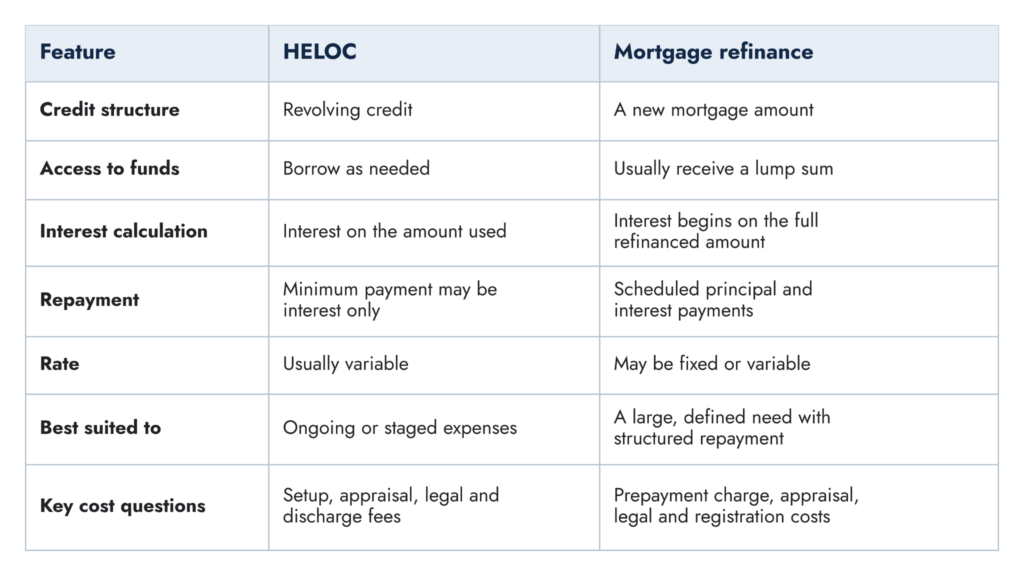
A HELOC may suit a renovation paid in stages or an emergency line that remains unused until needed. Mortgage refinancing may be more appropriate when the homeowner needs a large amount immediately and wants principal included in every scheduled payment.
Timing matters. Reviewing both options near a mortgage renewal date may reduce or avoid a midterm prepayment charge, but the overall rate and fees still need to be compared.
Risks and Considerations Before Getting a HELOC
A HELOC can be flexible, but the security behind it raises the stakes. The agreement should be treated as a long-term debt commitment even if the original reason for borrowing is temporary.
Consider these risks before opening or increasing a line:
- The Home is Collateral: Missed payments can lead to serious collection action and may ultimately put the property at risk.
- Rates Can Rise: Most HELOCs have variable rates linked to the lender’s prime rate; a change can increase interest costs and minimum payments.
- Minimum Payments May Not Reduce Debt: Interest-only payments can leave the original balance outstanding for years.
- Easy Access Can Encourage Overspending: A large available limit can feel like savings even though every withdrawal creates debt.
- Borrowing Reduces Equity: Less equity may be available for a future sale, move, retirement plan or financial emergency.
- Fees Can Add Up: Appraisal, legal, administration, title search, cancellation and discharge costs may apply.
- Lender Terms Can Change: The agreement may allow the lender to adjust the rate, reduce the limit or require repayment in certain circumstances.
Before borrowing, test the budget at a higher rate and decide how much principal will be paid each month. If the payment plan works only while rates stay unchanged, the line may be too large.
Common Uses for a HELOC
There is no universally good use of home equity. The purpose should match the borrower’s timeline, risk tolerance, and repayment capacity; a productive use can still create financial pressure if the debt remains open too long.
- Renovating a home: A HELOC can fund invoices in stages. Homeowners deciding between a major renovation and a different property may first compare building vs. buying a home in Canada.
- Consolidating debt: Replacing higher interest balances may reduce the monthly interest cost, provided old accounts are not run up again.
- Funding education: A line can cover tuition or related expenses, but students and families should compare dedicated education funding before using the home as security.
- Investing: Borrowed funds may support an income-producing investment, but returns are uncertain while HELOC interest is payable. Anyone considering an investment property should model vacancies, repairs, taxes, and rate changes.
- Purchasing another property: Equity may contribute to a down payment. Separate guidance is available for buying a vacation property and for homeowners planning a move through next home mortgages.
- Managing business expenses: Short-term working capital may be one use, but personal property is then exposed to business risk. A purpose-built commercial mortgage may be more suitable for a commercial acquisition.
- Covering an emergency: A HELOC can provide temporary liquidity, but it is safest when paired with a defined repayment date and a plan to rebuild cash reserves.
Using borrowed equity to make a down payment can also affect qualification for the new mortgage because the HELOC payment becomes part of the debt assessment. Obtain a full borrowing review before making an offer.
Tips for Using a HELOC Responsibly
Responsible use of home equity begins before the first withdrawal. Clear limits and automatic repayment habits help prevent a flexible credit tool from becoming permanent debt.
- Set one specific purpose for the account
- Request only the credit limit you reasonably need
- Prepare a repayment schedule before withdrawing funds
- Pay more than the minimum whenever the budget allows
- Avoid using the line for routine lifestyle spending
- Track every withdrawal, particularly when funds have mixed personal and investment uses
- Review the rate and monthly interest cost regularly
- Keep room in the budget for a higher variable rate
- Maintain an emergency fund separate from available credit
- Reassess the balance whenever income, property plans or financial goals change
A useful rule is to treat each withdrawal like a separate loan. Record the amount, purpose, target payment and planned payoff date. This makes it easier to see whether the line is solving a short-term need or quietly extending it.
Is a HELOC the Right Way to Access Your Home Equity?
A HELOC can provide flexible access to a homeowner’s equity, with interest charged only on the balance used. That flexibility is most valuable when the purpose is defined, the cost has been compared with other options, and the borrower can pay principal consistently.
Before applying, confirm:
- How much funding is actually required
- Whether the expense is one-time or ongoing
- How the balance will be repaid
- Whether the budget can absorb a higher rate
- Which appraisal, legal, setup, and discharge fees apply
- How the new debt affects future mortgage or property plans
The largest available limit is not automatically the right limit. A mortgage professional can compare lenders, HELOC structures, and refinancing options using the same financial assumptions. To review your goals and understand which approach fits your situation, find a broker with Mortgage Intelligence.
This article provides general information; lender policies, product terms, and tax treatment can vary.
Frequently Asked Questions
- How much equity do I need for a HELOC in Canada?
Current federal consumer guidance states that a standalone HELOC generally requires more than 35% equity, while a HELOC combined with a mortgage generally requires 20% equity. Meeting the equity threshold does not guarantee approval; income, debts, credit, and the property are also assessed.
- Is a HELOC better than a mortgage refinance?
Neither option is always better. A HELOC may suit expenses that occur over time, while refinancing may suit one high planned cost and a structured principal repayment schedule. Compare the rate, fees, prepayment charge, cash flow, and total interest under both options.
- Does a HELOC affect my credit score?
Applying may involve a hard credit inquiry. After approval, payment history, the balance carried, and overall credit use can affect the credit profile. Consistent on-time payments support healthy credit management; missed payments can cause significant damage.
- What is the interest rate on a HELOC?
There is no single rate for every borrower. Most HELOCs use a variable rate expressed as the lender’s prime rate plus or minus a margin. Compare the margin, fees, and payment rules rather than relying only on the advertised rate.
- Can I use a HELOC to pay off debt?
Yes, a HELOC can consolidate higher interest debt. The strategy works only if the borrower follows a principal repayment plan and avoids rebuilding balances on the accounts that were paid off. It also changes unsecured debt into debt secured by the home.
- Is HELOC interest tax deductible in Canada?
Interest is generally not deductible merely because the loan is secured by a home. The use of the borrowed money matters. The Canada Revenue Agency’s current guidance on carrying charges and interest expenses says that most interest paid on money borrowed and used to try to earn investment income may be claimed, subject to the applicable rules. Interest on personal spending is generally not deductible. Keep a clear transaction trail and consult a qualified tax professional about your circumstances.